










Delicious free Mexican food all summer long? Check and check.
Wait, wait…what???
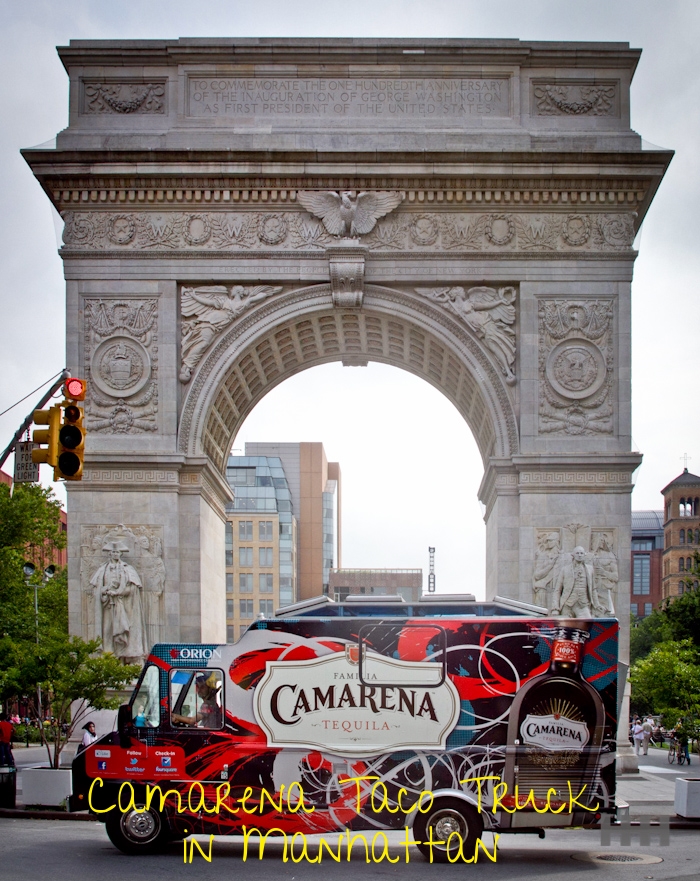
We hope you didn’t miss it. Yesterday was the last day of a summer-long promotion featuring free food courtesy of Famila Camarena Tequila. But we don’t want the free food to distract you from what’s really important… the tequila baby! Prominent Los Angeles food blogger Street Gourmet LA says “Its the best tequila at its price point!” and Rebel is delivering the samples.
Familia Camarena and Rebel enlisted chef to the stars and owner of Recess in Glendale, Chef Sevan Azarian to create an original tequila-infused menu that was served from the truck. Asada, carnitas, and pollo, all marinated in Camarena Tequila. What ever you want, we got it (well almost). Even a veggie option!
The truck was sent rolling around greater Los Angeles from June through August hitting shopping areas, nightclubs, and lifestyle events like: DTLA Art Walk, World Cup screenings at Nike Montalban Theatre, the LA Street Food Fest, and was even featured in Static Revenger’s new video for Vega$. We also did a private house party with a performance by Bruno Mars.
As you might have guessed, the truck was extremely well received. I mean c’mon, who doesn’t want free tacos? The free food is definitely an attraction in itself, but again we’re here for the tequila. Just ask Elvis, he’s down with Camarena.
So you think you understand how to market to Gen Y. Perhaps you’ve run some focus groups and and subscribed to one of those great trend reports.
If so, you may be privy to eye-opening information such as: their favorite brand is Apple, they don’t trust advertising, and they really like brands who do something positive for the environment. Profound.
Well, as this New York Times article illustrates, there’s a strong possibility that you don’t know sh!t. Here’s a little sample, just an example…
The 20s are a black box, and there is a lot of churning in there. One-third of people in their 20s move to a new residence every year. Forty percent move back home with their parents at least once. They go through an average of seven jobs in their 20s, more job changes than in any other stretch. Two-thirds spend at least some time living with a romantic partner without being married. And marriage occurs later than ever. The median age at first marriage in the early 1970s, when the baby boomers were young, was 21 for women and 23 for men; by 2009 it had climbed to 26 for women and 28 for men, five years in a little more than a generation.
“Why does this matter?” you ask. Because if you’re going to sell to them, you need to understand them as people.
On a basic level, your demographics are skewed. Income levels have different meanings if someone lives at home. And if they’re not saving for a wedding, they have opportunities to do different things with their money.
But it goes so much deeper than that. These people live differently than you, which means they think differently than you, or than what you’re used to. They have different ideals, priorities, values. And the things that motivate them to spend with you are probably not immediately apparent. You might think that the cool Facebook app is enough to be down with the kids, but lasting success depends on developing an intimate understanding of who your customers really are.
How to do that is a topic for another post. If you’re serious about, we can help you. For now, let’s just say it may mean getting out from behind your desk and doing a little real work out in the field. Are you ready?
For the rest of you, a question: Does packaging matter for the wines you buy? Is it all about the Parker score? A friend’s recommendation? A sommelier’s suggestion?
For most people, package design is important. It catches our attention, communicates positioning, attracts or repels us. I’m not telling you anything here. But somehow, the wine business has largely been immune to innovations in design. There are literally tens of thousands of French, Italian, and German bottles that look almost exactly alike. In the U.S., we have more than 5,000 domestic producers, most of whom choose — as if from a catalog — between classic, down-to-earth, or contemporary label looks.
Don’t believe me? Perhaps you can think of your favorite wine that has an interesting label —the black-on-black one that just seems really cool. Take a stroll down the wine aisle in a grocery store. It’s a sea of sameness that always leaves me wondering how they sell any wine at all.
Anyhow, the good people at thecoolist.com have managed to come up with a selection of really good, innovative wine packages. They don’t all appeal to me — I don’t see myself drinking wine out of an oil can anytime soon. But that’s the point of good packaging, isn’t it? Help people find you and decide whether or not to buy you.
What about you? What are your favorites on this list? Or do you have another great wine label to share? Let’s see it.
What that really means is that the old print magazine business is dead. You remember: Print a ton of copies and stack them high on magazine stands. Try to sell half of them (a sell-through rate of 50% was considered great) for dirt cheap (12 issues for only $10!). Fill each copy with no fewer than seven (7) subscription cards, some bound in and some loose so they would fall out onto the floor to beg the reader’s attention. Oh, and don’t forget the big celebrity photo on the cover, with another big celebrity in a bubble near the top. And use orange (or some other color du jour) on the cover. And the single-copy price has to end in $.95. Those are scientifically proven to increase circulation.
Yeah, that business is dead.
You know what isn’t dead? Making a great product for an audience who cares and charging money for it.
The guys at Monocle get this. The British magazine blends crosses several different categories, as the site describes: “a global briefing covering international affairs, business, culture and design.”
It’s well written and well designed. And the content is interesting. But Monocle is much more than that. There are shops in London, Los Angeles, Tokyo, and Hong Kong that sell exclusive products from small home furnishings to bikes and clothing. There are events available only to subscribers.
In other words, there’s a complete brand experience.
The best part: a year’s subscription is $117 (75 pounds). They’re not begging you to pick them up with two issues FREE! They’re making a good product and charging real money for it.
That may not be the future of print, but it may be the future of business.
These guys get it. Not only do they make great products, but they understand there’s nothing like making the kids giggle to get the cash register ringing.
Okay, this might be too edgy for some brands, but what can you do to make people laugh and maybe think you’re kinda clever? Post a comment here or let us know if you need help thinking of something.
In what appeared to be a 60/40 split between actual industry professionals and droves of goober, *oops*, I mean uber-gamers, the 3-day videogame tradeshow E3 has left LA just as swiftly as it had descended upon us… But not without plenty of online content for those who could not attend, provided by those privileged and/or crafty enough to enter the pearly gates of gamer heaven.
Who won the console war? While I desperately wanted to cheer for my former coworkers at Sony, I’m still trying to figure out which feature to consider “the big news” out of their 2-hour press conference. I hope it wasn’t the 3-D software titles that required the funky glasses because Nintendo’s 3DS does not. Was it all about accessories and the very phallic PlayStation Move that functions an awful lot like the Wii released 4 years ago? SMH. Was this supposed to extend the life of the PS3? Did they really not know about Xbox’s controller-less Kinect available in time for holiday 2010? (Eek, tail between Sony’s legs.) One good thing that came out of that press conference for me was discovering Jesper Kyd, composer for Assassins’ Creed (Ubisoft). This is the kind of music that builds excitement, not 1994′s “I like to ‘move’ it, ‘move’ it” that accompanied the sizzle reel for PlayStation Move. (You pick, SMH or tail between the legs)
As for the convention center floor, I couldn’t see myself standing in hour-plus lines for anything. I appreciated the booth babes (maybe not exactly in the same way as the boys did) and I gave them what they wanted – a friendly smile after a vertical scan of their goods. Thank you Spike TV for capturing the E3 booth babes and getting down to the important issues (how to successfully approach a booth babe).
I would have stood in line for Activision’s concert featuring Eminem, Travis Barker and Rihanna (is this stuff really just for the trade?). I’m upset I missed Russ, Red and Meth for their Def Jam/Konami mash up announcement and performance. I was happy to have my first experiences with the iPad though Josh and I were both perplexed by the ported iPhone apps that were clearly not optimized for iPad’s larger screen. Moreover, how not fun are digital comics that don’t optimize the technology – even the open pinch zoom so that the comics would actually be legible? : X
Until next year, we move on to celebrate another Laker victory (oh yeah) and offer our photo recap of E3.
Rebel needs a community manager. If you love social media and can be engaging and persuasive in both English and French, we want you down with the team.
Extra credit if you love cars and / or have experience with automotive marketing.
This is a contract position. We don’t care where you live. Just be smart, reliable, and organized, and able to work independently.
Disclaimer: This post may not be all that helpful.
I just need to vent. I’ve just come from the YouTube page for the United States Treasury, which features a “viral” video for the new $5 bill, as well as an unveiling of the new $100.
The $100 spot offers a walkaround as if to show us the features of a new car, while the $5 clip is a little infomercial packed with consumer reactions.
This is complete insanity. Why would anyone feel the need to market money? And where did they get the money to market money? Who approved this? There’s a long list of people who need to be fired immediately.
My guess is this is a case of someone taking the job a little too seriously and paying too much attention to all of the hype around social media. Sure, over 800,000 people watched the Ben Franklin video, but so what? Most of those people don’t have jobs, and won’t be getting their hands on a bill anytime soon. And even if they do, so what?
It seems obvious to me that money has no intrinsic value. That is, it doesn’t matter how nice the bill is, or how much it costs to print. The only thing that matters is what I can buy with it. Am I missing something? Is there some conceivable reason why it would be important for me to feel good about the $5 bill in my pocket, other than the fact that I can take it out of my pocket to buy a Hot Pocket? Or something else cheap that rhymes with pocket?
Someone please tell me why this makes sense. I would have written them directly, but of course comments have been disabled on the page.
For all the folks out there — haters and otherwise — who continue to question the validity of Twitter as a communication medium, y’all need to pay attention.
media.twitter.com isn’t just a blog. It’s an important step forward in the evolution of technology-based communication.
MySpace started us off on the wrong foot by building a massive audience and not knowing quite what to do with it themselves. Let’s assume they did their best to learn on the fly how to turn their website into a marketing platform, and as it goes with trial and error, success was very hit or miss (with lots of emphasis on “miss”). Most importantly, in typical old-media fashion, the assistance they provided was for serious advertisers only and it involved swarms of sales support teams and conference calls to help you figure out what to do to reach their crowd.
Then Facebook came along, with its brashness and anti-corporate attitude. Kind of like, “we don’t care, you figure it out.” It’s taken years for them to come around, and even now most of their assistance is human-based. And it’s mostly around advertising programs, rather than community building.
So now here’s Twitter, putting it all out there on a blog for anyone to see. Their open style is the way of the future. They’re giving us tips and case studies. It’s almost like they want us to be successful using their service. What a crazy concept!
I’m not arrogant enough to predict where social media is heading, and I’m not here to say it’s going to be all about Twitter. But I am certain that as things continue to get more complicated, the companies who take an active role in creating win-win relationships between marketers and their audiences will have a huge advantage.
This TED Talk is from Eric Giler, CEO of a company called WiTricity, which has developed a technology that will power and charge our electronic devices, wirelessly. This is a company that could change the world.
Think about it. Our phones, computers, gadgets, and cars are increasingly complex and powerful. The one thing that holds them back is power. iPhone’s battery life is terrible. So is MacBook’s. Electric cars may be the future, but they have to be plugged in, which sucks. This limits our mobility, our productivity, and possibly the resulting happiness that comes from things like mobility and productivity.
Where am I going with this?
Imagine if Coke had bought Twitter a couple years back. Its >70 million users would be exposed to Coke branding that many more times than they already are. Think that would be significant for Coke’s business? Damn straight. Now think about Facebook, Foursquare, Google, and the other companies that are changing lives and societies on a daily basis. What if instead of spending billions of dollars to advertise on these networks, major consumer brands spent just a fraction of that amount in early-stage investment capital to fund these companies? Guess what:
They’d have a better understanding of consumer behavior
They’d make money, possibly lots and lots of money
They’d earn the goodwill of being positioned as forward-thinking and innovative
They’d have countless opportunities for integration and cross-promotion
Back when I started the Rebel Organization, the premise was that major corporate money should go to investing in culture. The vision was that brands could fund records, create works of art, invest in movies. Instead of waiting for an act to become huge and then spend for a tour sponsorship that nobody cares about, put the money in early to support artist development and have a fan for life in the artist, and that artist will tell all of his fans.
We were somewhat successful in that endeavor, but we’ve never brought it to the scale it deserves.
Russell Simmons recently called social media “the New Hip Hop.” I agree completely, and that idea is reshaping my vision for a future where in addition to (or instead of) investing in culture, brands should also be investing in social technologies.
Heed my word: smart marketers will gain tremendous advantage over their slower competitors. Which one are you?
Rebel Industries puts clients face-to-face with the people they want to speak to most. We plan and activate grassroots marketing that integrates strategy with guerilla, experiential, buzz, interactive, and social media to impact urban, youth, affluent, and other lifestyles. Our blog discusses emerging trends, highlighting the people and companies who are changing the future of brands.